
Pakistan suspended its Visa on Arrival (VOA) and Visa Prior to Arrival (VPA) programs on January 1, 2026. All foreign nationals who previously qualified for visa on arrival must now apply for an eVisa in advance through the NADRA online portal. The suspension affects travelers from 50 countries who could previously obtain tourist or business visas upon landing at Pakistani airports and land borders. Gulf Cooperation Council (GCC) nationals remain exempt and can still enter Pakistan without any visa for up to 90 days.
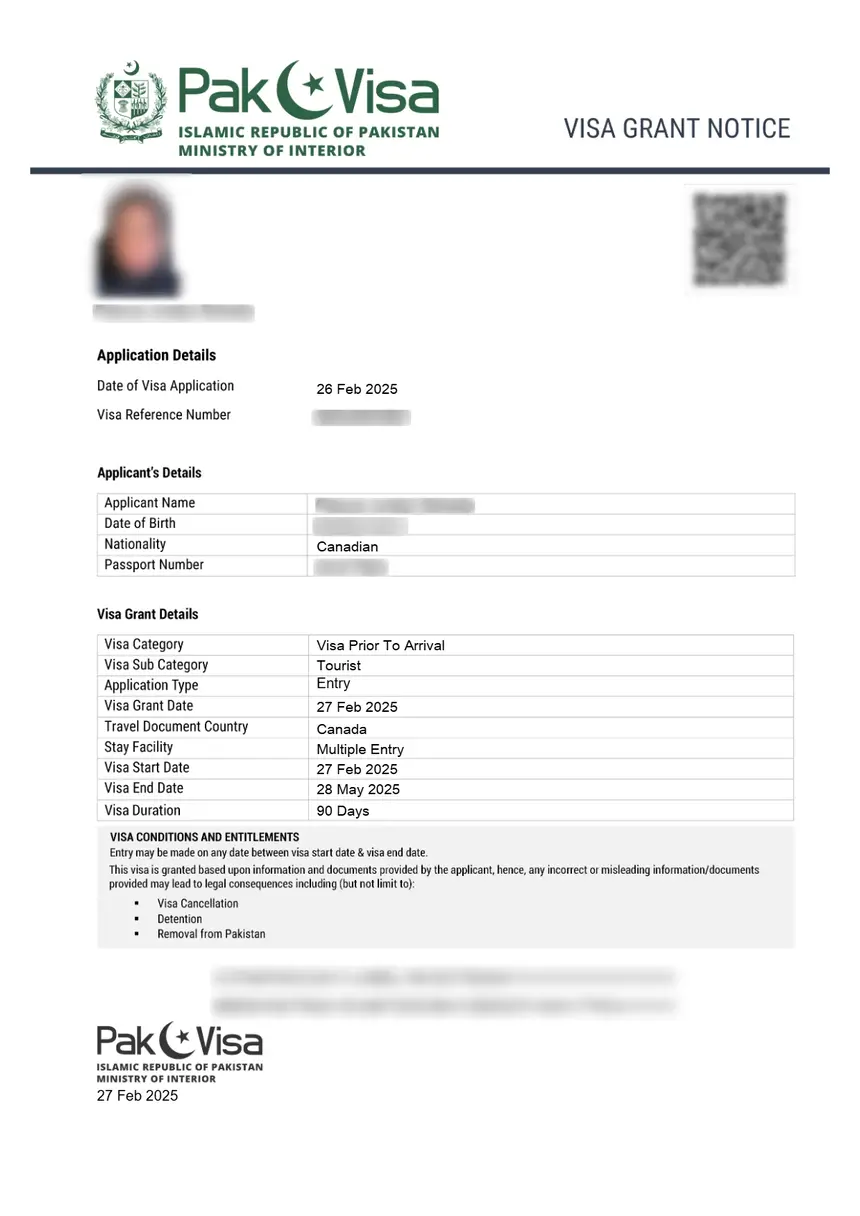
This guide explains what happened to Pakistan’s visa on arrival program, which countries were affected, and what you need to do instead to visit Pakistan in 2026.
What was Pakistan visa on arrival?
Pakistan’s visa on arrival program allowed citizens of 50 approved countries to obtain a tourist or business visa at the airport or border crossing upon arrival in Pakistan. The program was part of Pakistan’s broader effort to simplify entry procedures and boost tourism, launched in 2019 and expanded through 2024.
Under the VOA program, travelers needed to:
- Hold a passport valid for at least 6 months
- Present a confirmed return ticket
- Show proof of accommodation (hotel booking or host invitation letter)
- Have sufficient funds (minimum USD 1,500 in cash or valid credit card)
- Apply for an Electronic Travel Authorization (ETA) 48-72 hours before arrival
The tourist VOA was valid for 30 days and was single-entry for most nationalities. Nationals of Malaysia, Turkey, and UAE received a 30-day multiple-entry visa on arrival.
Business visa on arrival was available to nationals of 50 countries through the Federation of Pakistan Chambers of Commerce and Industry (FPCCI) arrangement, requiring a business invitation letter.
Visa Prior to Arrival (VPA) – the free alternative
The Visa Prior to Arrival (VPA) was a separate, more convenient program that offered free electronic pre-travel authorization, usually processed within 48 hours. This was available to 126 nationalities and was the preferred option for most travelers because:
- It was completely free (no visa fee)
- Processing took only 1-2 working days
- It eliminated uncertainty at the airport
- Could be obtained entirely online
The VPA was effectively Pakistan’s version of an eTA (Electronic Travel Authorization), similar to systems used by Canada, Australia, and New Zealand.
Why was Pakistan visa on arrival suspended?
Pakistan suspended both the VOA and VPA programs effective January 1, 2026, without issuing a formal public announcement. According to immigration law firm Fragomen, the suspension came without prior notice, and it remains unclear whether the change is temporary or permanent.
Several factors likely contributed to the decision:
- Security concerns: Pakistan has faced ongoing security challenges, and advance vetting allows authorities to screen travelers before they arrive
- Overstay management: Some VOA holders overstayed their 30-day permits, creating enforcement difficulties
- System consolidation: Pakistan’s Directorate General of Immigration and Passports (DGIP) streamlined its 18 visa categories down to 11 in 2024, and this suspension may be part of further consolidation
- Revenue considerations: The free VPA generated no revenue, while the standard eVisa requires application fees
The suspension affects both the tourist visa on arrival and the business visa on arrival categories. Travelers who previously relied on these programs now have two options: apply for an eVisa online, or apply at a Pakistani embassy or consulate.
Countries affected by the VOA suspension
The following 50 countries whose nationals were eligible for Pakistan visa on arrival are now affected by the suspension:
| Country | Country | Country |
|---|---|---|
| Angola | Argentina | Austria |
| Azerbaijan | Bahamas | Bahrain |
| Barbados | Botswana | Brunei |
| Costa Rica | Finland | Germany |
| Ghana | Iceland | Indonesia |
| Italy | Japan | Jordan |
| South Korea | Kuwait | Lithuania |
| Luxembourg | Malaysia | Maldives |
| Malta | Monaco | Mozambique |
| Nepal | New Zealand | Oman |
| Paraguay | Qatar | Rwanda |
| Saint Kitts and Nevis | Saint Lucia | Saudi Arabia |
| Singapore | Spain | Sri Lanka |
| Switzerland | Tajikistan | Tanzania |
| Thailand | Tonga | Trinidad and Tobago |
| Tunisia | Turkey | UAE |
| Western Samoa | Zambia |
Note: This list reflects the countries that were eligible before the January 2026 suspension. The VOA program is currently inactive for all these nationalities.
Who can still enter Pakistan without a visa?
Not all travelers are affected by the VOA suspension. Several categories of visitors can still enter Pakistan without applying for any visa:
GCC nationals – 90-day visa-free entry
Citizens of Gulf Cooperation Council countries continue to enjoy visa-free entry to Pakistan for up to 90 days:
- Bahrain
- Kuwait
- Oman
- Qatar
- Saudi Arabia
- UAE
This visa-free arrangement is a separate bilateral agreement and is not affected by the VOA suspension. GCC nationals do not need an ETA or any pre-travel authorization.
Visa-free for 30 days
Nationals of the following countries can enter Pakistan visa-free for up to 30 days:
- Maldives
- Nepal
NICOP and POC holders
Holders of a Pakistan Origin Card (POC) or National Identity Card for Overseas Pakistani (NICOP) do not need a visa regardless of their passport nationality. This includes dual nationals and persons of Pakistani origin. Learn more about NICOP visa exemption.
Diplomatic and official passport holders
Holders of diplomatic, official, and service passports from numerous countries enjoy visa-free entry under reciprocal bilateral agreements. The duration varies by country and passport type.
What to do instead: Pakistan eVisa
With the VOA suspended, the primary way to visit Pakistan is through the Pakistan eVisa system, managed by NADRA (National Database and Registration Authority). The eVisa is available to nationals of nearly all countries except India and Taiwan.
eVisa requirements
To apply for a Pakistan eVisa, you need:
- A passport valid for at least 6 months beyond your planned entry date
- A scanned copy of your passport’s biographical page
- A recent passport-style photograph (white background, JPEG/PNG format, up to 350KB)
- Completed online application form
- Hotel booking or host invitation letter (for tourist visa)
- A credit or debit card for fee payment
- A Google account (required for 2FAS authentication on the portal)
eVisa processing time
The standard eVisa processing time is 7-10 business days, significantly longer than the 1-2 days offered by the old VPA program. Some applicants report waiting up to 20 business days during peak periods. Plan accordingly and apply well in advance of your travel dates.
| Visa type | Processing time | Validity |
|---|---|---|
| Tourist eVisa (single entry) | 7-10 business days | Up to 3 months |
| Tourist eVisa (extension) | 7-10 business days | Up to 6 months total |
| Business eVisa | 7-10 business days | Varies by nationality |
| US tourist (5-year multiple entry) | 7-10 business days | 5 years, 3-month stay per entry |
How to apply for a Pakistan eVisa
- Visit the official portal at visa.nadra.gov.pk
- Create an account using your email address and a Google account for 2FA
- Select your visa type (tourist, business, family visit, etc.)
- Fill out the application form completely – blank fields can cause automatic rejection
- Upload your passport scan and photograph
- Upload supporting documents (hotel booking, invitation letter)
- Pay the fee online with a credit or debit card
- Submit your application
- Check your email regularly – the approved eVisa arrives as a PDF
For a detailed walkthrough, see our eVisa application guide.
eVisa fees
Pakistan eVisa fees vary by nationality due to the reciprocal fee structure. Some nationalities benefit from fee waivers – Pakistan exempts citizens of 126 countries from visa fees as of August 2024.
| Nationality | Tourist eVisa fee | Notes |
|---|---|---|
| US citizens | Varies | 5-year multiple entry available |
| UK citizens | Varies | Standard tourist category |
| Most nationalities | Check visa.nadra.gov.pk | Fee structure is nationality-specific |
| 126 exempt countries | Free | Fee waiver since August 2024 |
Check the exact fee for your nationality at visa.nadra.gov.pk/fee-structure or see our complete Pakistan visa fee breakdown.
Visa on arrival alternatives by traveler type
Different travelers have different options depending on their nationality and purpose of visit:
For tourists from former VOA countries
Apply for a tourist eVisa at least 3-4 weeks before your trip. The 7-10 business day processing time can extend during busy periods. US nationals should consider the 5-year multiple-entry option if they plan repeat visits.
For business travelers
The business eVisa replaces the former business VOA. You will need an invitation letter from a Pakistani company. For business travelers from BVL (Business Visa List) countries, processing may be faster – up to 24 working hours. See our Pakistan business visa guide for details.
For GCC residents
If you hold GCC citizenship, you do not need any visa at all – just bring your passport and enjoy 90-day visa-free entry.
For Indian nationals
Indian passport holders were never eligible for the VOA program. Indian nationals must apply through the Ministry of Interior and are subject to special restrictions including mandatory police registration and limited entry ports. See our guide for Indian citizens traveling to Pakistan.
For Afghan nationals
Afghan citizens face additional requirements and are not eligible for most visa categories. See our Afghan citizens visa guide.
Will Pakistan visa on arrival be restored?
As of July 2026, there is no official announcement regarding the restoration of the visa on arrival or Visa Prior to Arrival programs. The DGIP has not issued any timeline or indication of whether the suspension is temporary or permanent.
The Fragomen analysis notes that the suspension happened without formal announcement, which suggests it may have been an administrative decision rather than a policy change requiring parliamentary approval. This could mean the programs could be restored at any time – but there are no guarantees.
Travelers should plan around the current eVisa system and not count on VOA being available for upcoming trips.
Frequently asked questions
Can US citizens get a Pakistan visa on arrival?
No. As of January 1, 2026, Pakistan has suspended its visa on arrival program for all nationalities, including US citizens. American travelers must now apply for an eVisa online through visa.nadra.gov.pk before traveling. US nationals are eligible for a 5-year multiple-entry tourist visa.
Is Pakistan visa on arrival cancelled permanently?
The suspension took effect on January 1, 2026, without a formal announcement. Pakistan has not confirmed whether the VOA and VPA programs will be restored. For now, travelers should assume the eVisa is the only option and plan their applications 3-4 weeks ahead of travel.
Which countries can enter Pakistan without a visa?
GCC nationals (Bahrain, Kuwait, Oman, Qatar, Saudi Arabia, UAE) can enter Pakistan visa-free for up to 90 days. Citizens of Maldives and Nepal enjoy 30-day visa-free entry. Holders of NICOP and POC cards are also exempt from visa requirements regardless of their passport nationality.
How long does a Pakistan eVisa take?
Standard processing is 7-10 business days, though it can take up to 20 business days during peak periods. This is significantly longer than the old VPA program, which processed in 1-2 days. Apply at least 3-4 weeks before your intended travel date.
Can I extend my Pakistan visa if I entered on a VOA?
No. If you entered Pakistan on a visa on arrival before the suspension, the VOA (valid for 30 days) cannot be extended. You must leave Pakistan before your VOA expires. For longer stays, apply for an eVisa instead, which can be extended up to 6 months through NADRA.
Do I need a Google account for Pakistan eVisa?
Yes. The NADRA eVisa portal requires a Google account for two-factor authentication (2FAS). You will need to use Google’s authenticator as part of the login process. Make sure you have a Google account set up before starting your application.
Related pages
- Pakistan eVisa Complete Guide – Step-by-step eVisa application walkthrough
- Pakistan Visa Types – All 11 visa categories explained
- Pakistan Tourist Visa – Tourist visa requirements and process
- Pakistan Visa Processing Time – Processing times for all visa categories
- Pakistan Visa Fee – Fee breakdown by nationality
- Pakistan Visa Free Countries – Countries with visa-free access to Pakistan