
Pakistan is home to some of the most significant religious sites in South Asia, attracting pilgrims and spiritual travelers from multiple faiths. From the birthplace of Guru Nanak in Nankana Sahib to the ancient Buddhist ruins of Taxila, and from the vibrant Sufi shrines of Lahore to Hindu temples in Sindh, Pakistan offers a rich tapestry of sacred destinations. This guide covers the major religious sites, visa requirements, and practical information for planning a religious tourism trip to Pakistan.
Why Pakistan Is a Major Religious Tourism Destination
Pakistan sits at the crossroads of several of the world’s great religions. The region that is now Pakistan has been a cradle of spiritual activity for millennia – Buddhism flourished here under the Gandhara civilization, Sikhism’s founder Guru Nanak was born in Punjab, Sufi saints established some of South Asia’s most revered shrines, and ancient Hindu temples dot the landscape of Sindh and Punjab.
In recent years, the Pakistani government has invested heavily in restoring and promoting religious tourism infrastructure. The opening of the Kartarpur Corridor in 2019 marked a historic milestone, allowing Indian Sikh pilgrims visa-free access to one of Sikhism’s holiest sites. The government’s Evacuee Trust Property Board (ETPB) manages over 1,300 religious sites belonging to minority communities across the country.
Sikh Pilgrimage Sites in Pakistan
Pakistan holds immense significance for the Sikh community worldwide. Several of the most important gurdwaras (Sikh temples) are located in Punjab province, drawing hundreds of thousands of pilgrims each year.
Nankana Sahib – Birthplace of Guru Nanak
Nankana Sahib, located approximately 91 km west of Lahore, is the birthplace of Guru Nanak (1469-1539), the founder of Sikhism. The city is named after him and is home to Gurdwara Janam Asthan, which marks the exact spot where Guru Nanak was born. This is one of the holiest sites in all of Sikhism.
The gurdwara complex includes several historically significant structures:
- Gurdwara Janam Asthan – the main shrine marking Guru Nanak’s birthplace
- Gurdwara Patti Sahib – where Guru Nanak learned the alphabet
- Gurdwara Bal Leela – associated with Guru Nanak’s childhood miracles
- Gurdwara Mal Ji Sahib – linked to an early miracle of Guru Nanak
- Gurdwara Kiara Sahib – where young Guru Nanak tended cattle
- Gurdwara Tambu Sahib – another historically significant shrine
Every year, thousands of Sikh pilgrims from India, Canada, the United Kingdom, the United States, and other countries travel to Nankana Sahib, particularly during the birth anniversary celebrations of Guru Nanak. The Pakistani government has made significant investments in the area, including the construction of the Baba Guru Nanak University and improved accommodation facilities.
Gurdwara Darbar Sahib Kartarpur
Kartarpur holds special significance as the place where Guru Nanak spent the last 18 years of his life and where he passed away in 1539. Gurdwara Darbar Sahib Kartarpur is located near Narowal in Punjab, just 4.7 km from the India-Pakistan border.
The Kartarpur Corridor, opened on 9 November 2019, connects Gurdwara Darbar Sahib Kartarpur in Pakistan with Dera Baba Nanak in India. This visa-free border crossing was built at a cost of approximately $88 million and allows Indian Sikh pilgrims to visit the gurdwara without needing a full visa. Pilgrims register online through a dedicated portal and receive a permit for same-day travel.
The corridor was a joint project between India and Pakistan, inaugurated to coincide with the 550th anniversary of Guru Nanak’s birth. It represents one of the most significant confidence-building measures between the two countries.
Important note: As of 2025, the Kartarpur Corridor has been suspended from the Indian side following regional tensions. Travelers should check the current status before planning a visit through this route. Pakistani Sikhs and international visitors can still access Kartarpur through the standard Pakistan eVisa process.
Gurdwara Panja Sahib (Hassan Abdal)
Gurdwara Panja Sahib is located in Hassan Abdal, about 40 km northwest of Islamabad. It is one of the most sacred Sikh shrines, believed to bear the handprint (panja) of Guru Nanak pressed into a boulder. According to Sikh tradition, Guru Nanak visited this site during one of his missionary journeys and the imprint was left when he placed his hand on a large rock.
The gurdwara attracts thousands of pilgrims annually, particularly during the festival of Baisakhi in April. The site is easily accessible from Islamabad and can be combined with a visit to the capital region.
Other Important Gurdwaras
- Gurdwara Dera Sahib, Lahore – marks the site where Guru Arjan Dev, the fifth Sikh Guru, attained martyrdom
- Gurdwara Rori Sahib, Eminabad – associated with Guru Nanak and his companion Bhai Mardana
- Gurdwara Sacha Sauda, Farooqabad – commemorates Guru Nanak’s “true bargain” of feeding hungry sadhus
- Gurdwara Choa Sahib, Jhelum – where Guru Nanak created a spring of water
Buddhist Heritage Sites in Pakistan
Pakistan’s Buddhist heritage is among the richest in the world. The ancient region of Gandhara, covering parts of modern-day Khyber Pakhtunkhwa and northern Punjab, was a major center of Buddhist learning, art, and culture for over a thousand years.
Taxila – UNESCO World Heritage Site
Taxila, located about 25 km northwest of Islamabad-Rawalpindi, is a UNESCO World Heritage Site and one of the most important archaeological sites in South Asia. Founded around 1000 BCE, Taxila was a center of learning that attracted students from across the ancient world.
The Buddhist sites at Taxila include:
- Dharmarajika Stupa – a massive stupa built by the Mauryan emperor Ashoka in the 3rd century BCE to house relics of the Buddha
- Jaulian Monastery – a well-preserved Buddhist monastery complex dating to the 2nd century CE
- Mohra Muradu – an exquisite Buddhist monastery with a main stupa and several smaller votive stupas
- Sirkap – the ruins of an ancient city with Buddhist, Hindu, and Jain temples
- Jinnan Wali Dheri – remains of a Buddhist stupa and monastery
The Taxila Museum houses an outstanding collection of Gandhara art, including some of the finest examples of Greco-Buddhist sculpture in the world. The museum contains over 4,000 objects, many depicting scenes from the life of the Buddha rendered in a distinctive Hellenistic style.
Takht-i-Bahi – UNESCO World Heritage Site
Takht-i-Bahi, meaning “Throne of the Water Spring,” is a remarkably well-preserved Buddhist monastery complex located about 15 km from Mardan in Khyber Pakhtunkhwa. Dating from the 1st to the 7th century CE, it is considered the best-preserved Buddhist monastery in Pakistan and was designated a UNESCO World Heritage Site in 1980.
The complex includes:
- A main stupa court with several smaller stupas
- Monastic cells where monks lived and meditated
- A tantric meditation center with individual cells
- A conference hall and refectory
- Several courtyard groups with their own stupas
The site is perched on a hilltop at an elevation of about 600 meters, offering panoramic views of the surrounding valleys. Its remote location helped preserve it from the destruction that affected many other Buddhist sites in the region.
Other Buddhist Sites
- Butkara I and II, Swat – major Buddhist stupa complexes in the Swat Valley
- Shingardar Stupa, Swat – one of the tallest Buddhist stupas in the subcontinent
- Sahri Bahlol – a UNESCO World Heritage Site near Takht-i-Bahi with Gandhara-era remains
- Mardan Museum – houses an important collection of Gandhara Buddhist art
Sufi Shrines and Islamic Heritage
Pakistan has an extraordinarily rich Sufi tradition, with shrines (dargahs) of great Sufi saints spread across the country. These shrines are visited by millions of devotees of all faiths throughout the year.
Data Darbar, Lahore
Data Darbar is the largest Sufi shrine in South Asia, housing the tomb of Ali al-Hujwiri (also known as Data Ganj Baksh), an 11th-century Sufi saint who came from Ghazni to Lahore. The shrine is considered the most sacred place in Lahore and attracts up to one million visitors during its annual urs (death anniversary) festival.
The shrine complex includes a mosque, library, madrasa, and extensive courtyard. A 1,000-year-old tradition continues where up to 50,000 visitors per day are offered free food. Qawwali (Sufi devotional music) performances are held regularly, and on special occasions the shrine is decorated with lights and flowers.
Shahbaz Qalandar, Sehwan Sharif
The shrine of Lal Shahbaz Qalandar in Sehwan, Sindh, is one of Pakistan’s most famous Sufi sites. The 13th-century saint is revered by Muslims and Hindus alike. The annual urs festival draws hundreds of thousands of devotees who participate in ecstatic dhamaal (Sufi dancing) to the rhythmic beats of drums.
Abdullah Shah Ghazi, Karachi
Located on a hilltop in the Clifton area of Karachi, the shrine of Abdullah Shah Ghazi is believed to date from the 8th century. The saint is considered the patron saint of Karachi, and the shrine attracts thousands of visitors daily.
Shah Abdul Latif Bhittai, Bhit Shah
The shrine of Shah Abdul Latif Bhittai, the great Sufi poet of Sindh, is located in Bhit Shah. The annual urs festival features traditional Sindhi music, poetry recitals, and spiritual gatherings.
Baba Farid, Pakpattan
The shrine of Baba Farid Shakar Ganj in Pakpattan, Punjab, is one of the oldest and most revered Sufi shrines in South Asia. Baba Farid (1173-1266) was a prominent Sufi saint whose verses are included in the Sikh holy book, the Guru Granth Sahib.
Hindu Temples in Pakistan
Despite the large-scale migration of Hindus during the 1947 partition, Pakistan still has a significant Hindu population, particularly in Sindh province, and several important Hindu temples remain active.
Hinglaj Mata Temple, Balochistan
The Hinglaj Mata temple, located in the Hingol National Park in Balochistan, is one of the most important Hindu pilgrimage sites in Pakistan. It is one of the 51 Shakti Peethas (divine seats of the goddess) in Hindu tradition. Every April, thousands of Hindu pilgrims travel through the desert to reach this remote shrine.
Katasraj Temple, Chakwal
The Katasraj Temple complex in Chakwal district, Punjab, is a group of Hindu temples surrounding a sacred pool believed to have been created from the tears of Lord Shiva. The complex dates back to the 6th century and includes several ancient temples in various states of preservation. The Pakistani government has undertaken restoration work on the complex in recent years.
Umarkot Shiv Mandir
The Shiv Mandir in Umarkot, Sindh, is one of the oldest Hindu temples in Pakistan. It is particularly significant during the Shivratri festival, when thousands of Hindu pilgrims gather to worship.
Sadhu Bela Temple, Sukkur
Located on an island in the Indus River near Sukkur, the Sadhu Bela Temple is a major Hindu pilgrimage site. The temple complex includes several shrines and is accessible by boat.
Christian Heritage Sites
Pakistan has a significant Christian minority, and several churches and mission sites are of historical interest.
- Sacred Heart Cathedral, Lahore – one of the oldest churches in Pakistan, built in 1907
- St. Patrick’s Cathedral, Karachi – a Gothic-style cathedral completed in 1881
- Taxila Cross – a bronze cross discovered at Taxila, possibly indicating early Christian presence in the region dating to the 1st century CE
Visa Requirements for Religious Tourism
Foreign nationals visiting Pakistan for religious tourism generally need a Pakistan eVisa. Here is what you need to know:
Standard Tourist eVisa
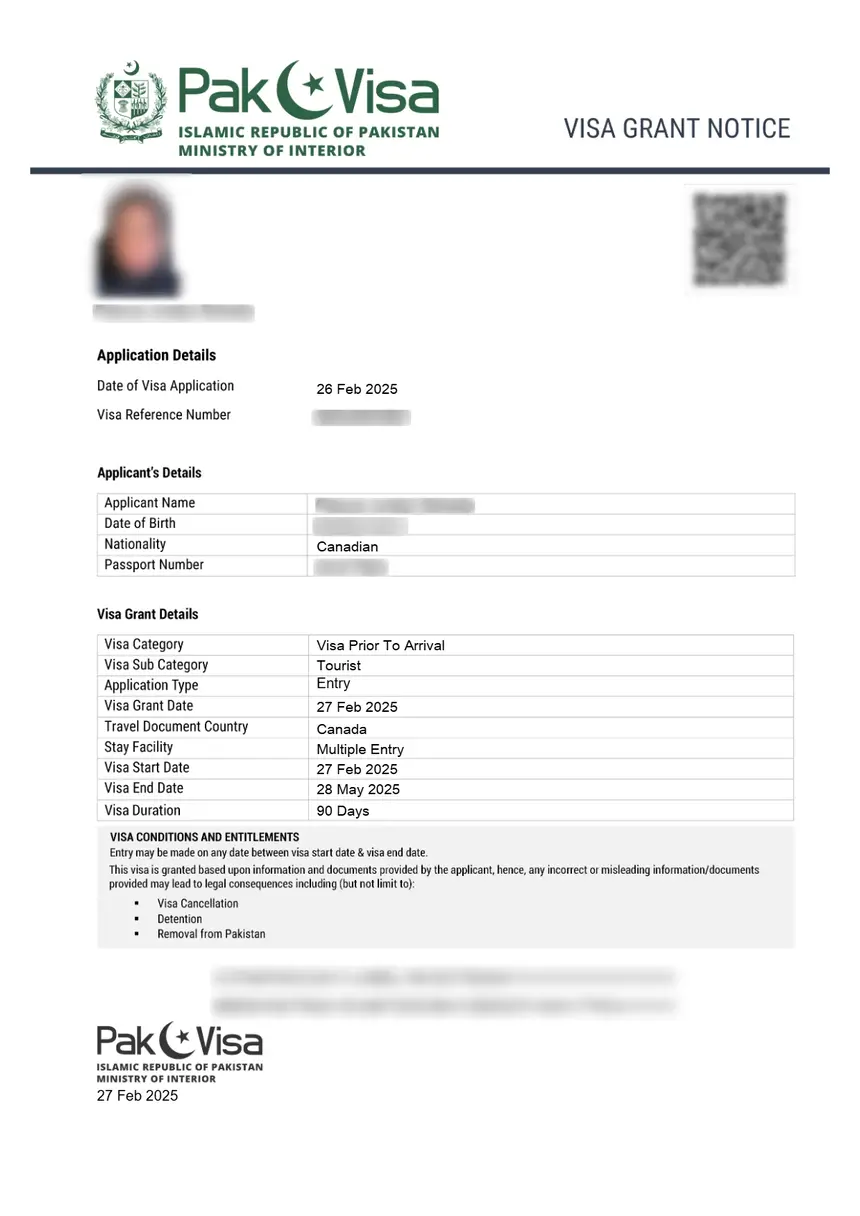
Most religious tourists can apply for the standard Pakistan Tourist eVisa through the online portal. This visa allows stays of up to 30 days (60 days for some nationalities) and is valid for 3 months from the date of issuance.
Requirements include:
– Valid passport with at least 6 months remaining validity
– Recent passport-size photograph
– Flight itinerary
– Accommodation proof (hotel booking or invitation letter)
– Completed online application
Processing typically takes 7 to 10 business days. Apply at least 3 weeks before your travel date.
Pilgrimage Visa for Sikh Visitors from India
Indian Sikh pilgrims visiting through the Kartarpur Corridor can do so visa-free with a special permit obtained through the dedicated online registration portal. For visits to other Sikh shrines in Pakistan, Indian nationals must apply for a special pilgrimage visa through the Ministry of Interior, as Indian passport holders are not eligible for the standard tourist eVisa.
Group pilgrimage visits are organized periodically under the 1974 Protocol on Visits to Religious Shrines between India and Pakistan. These visits are coordinated through the respective governments and cover specific shrine sites.
Group Pilgrimage Visas
Many religious communities organize group pilgrimage visits to Pakistan. The Evacuee Trust Property Board (ETPB) coordinates visits for Sikh, Hindu, and other religious groups. Group visa applications may be processed more quickly when organized through recognized religious bodies.
Practical Tips for Religious Tourists
Best Time to Visit
- October to March – the most comfortable weather for travel across Pakistan
- April – Baisakhi celebrations at Sikh gurdwaras; Hinglaj Mata pilgrimage
- November – Guru Nanak’s birth anniversary (Guru Purab) celebrations at Nankana Sahib
Accommodation
Major religious sites in Pakistan have increasingly developed accommodation options:
- Nankana Sahib – Nankana Lake Resort and several guesthouses
- Taxila – Hotels in nearby Islamabad-Rawalpindi (25 km)
- Lahore – Full range of hotels from budget to luxury
- Sehwan Sharif – Basic accommodation near the shrine
Getting Around
- Domestic flights connect major cities (Islamabad, Lahore, Karachi, Peshawar)
- The motorway network connects Lahore, Islamabad, and Peshawar efficiently
- Hiring a car with driver is recommended for visiting multiple religious sites
- Organized tours through registered operators provide the most convenient experience
Safety Considerations
Pakistan has significantly improved its security environment in recent years. Most major religious sites are well-protected with dedicated security arrangements. However, travelers should:
- Check current travel advisories from their government
- Register with their embassy upon arrival
- Travel with a local guide or through an organized tour
- Follow local security guidance at shrine complexes
- Be aware that some areas near the Afghan and Indian borders may require special permits (NOCs)
Cultural Etiquette
- Remove shoes before entering any place of worship
- Dress modestly – cover shoulders and knees, women should carry a head covering
- Ask permission before photographing people or religious ceremonies
- Respect local customs at Sufi shrines – some areas may be restricted by gender
- At Sikh gurdwaras, cover your head (scarves are usually provided) and do not wear shoes inside
Frequently Asked Questions
Can non-Muslims visit Sufi shrines in Pakistan?
Yes. Sufi shrines in Pakistan are open to visitors of all faiths. Many Sufi saints are revered by Muslims, Hindus, Sikhs, and Christians alike. The inclusive tradition of Sufism means that these shrines welcome everyone.
Do I need a special visa to visit Buddhist sites in Pakistan?
No. The standard Pakistan Tourist eVisa covers visits to all Buddhist heritage sites, including Taxila and Takht-i-Bahi. No special pilgrimage visa is required for Buddhist tourists.
How do Indian Sikh pilgrims visit Pakistan?
Indian Sikh pilgrims can visit through the Kartarpur Corridor (when operational) without a visa, or apply for a pilgrimage visa through the Ministry of Interior for visits to other gurdwaras. Group pilgrimages are also organized periodically under the bilateral protocol on visits to religious shrines.
Are there organized religious tours in Pakistan?
Yes. Several licensed tour operators in Pakistan specialize in religious tourism packages covering Sikh, Buddhist, Sufi, and Hindu heritage sites. These tours typically include transportation, accommodation, guides, and security arrangements.
What is the Evacuee Trust Property Board (ETPB)?
The ETPB is a Pakistani government body that manages religious properties and sites belonging to minority communities that were left behind during the 1947 partition. It oversees more than 1,300 properties across Pakistan, including gurdwaras, temples, churches, and mosques.